
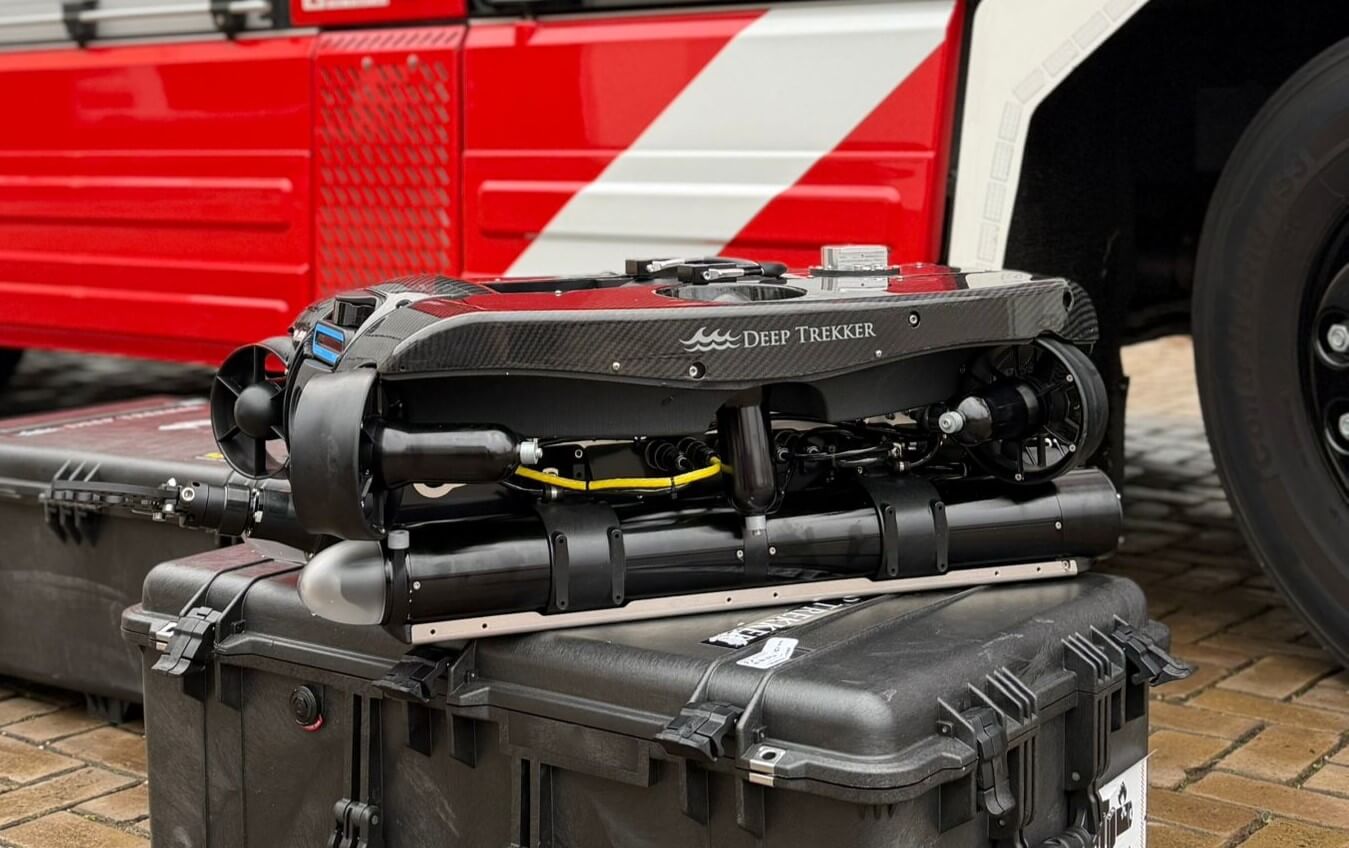
When a report comes in that someone has fallen into the water, a race against the clock begins. Emergency services must act quickly, whilst also ensuring they work safely. Underwater conditions are often far from ideal. Visibility is limited, currents can be treacherous and the environment is usually unfamiliar. It is precisely for this reason that an increasing number of safety regions are choosing to deploy an underwater drone to support their diving teams and search and rescue missions.
The Rotterdam-Rijnmond Safety Region and the South Holland South Safety Region are among the organisations now using this technology to carry out search and rescue operations more safely and efficiently.
The reality of an underwater search operation
To outsiders, underwater search and rescue can sometimes seem relatively straightforward: a diver enters the water and begins searching. In practice, however, it is one of the most challenging disciplines within the emergency services. In many waters, underwater visibility is often no more than one to two metres. As a result, divers must rely largely on their training, experience and instincts.
This entails certain risks. There may be obstacles underwater, such as cables, branches, wreckage, jetties or other structures in which a diver could become entangled. Furthermore, emergency responders do not always know in advance what the situation is like beneath the surface. Every operation therefore begins with a certain degree of uncertainty.
Within the fire service, therefore, there is an important guiding principle: to minimise risks as much as possible without losing sight of the quality of the rescue operation. Technology can play a key role in this.
Look first, then dive
At H2O Drones, we do not see an underwater drone as a replacement for a fire service diver in search and rescue operations, but as an extra pair of eyes underwater. Whereas a diver is immediately exposed to the conditions, an ROV (Remotely Operated Vehicle) can first reconnoitre the environment without putting people at risk.
During a search and rescue mission, the ROV located the site and guided the diver to it
This provides incident commanders and dive coordinators with valuable information. Even before a diver enters the water, it is possible to determine what the search area looks like, what obstacles are present and where potential areas of concern are located. This allows divers to be deployed in a much more targeted manner and significantly increases the safety of the operation.
Particularly in search and rescue operations, where speed is crucial, this approach can save a great deal of time. There is less need to work on the basis of assumptions, and the likelihood of unexpected surprises underwater is reduced.
Sonar sees what the human eye cannot
The real power of modern underwater drones lies not only in the camera, but above all in the sonar. Whilst cameras rely on visibility and lighting, sonar uses sound waves to reveal objects and structures. As a result, the system continues to function effectively in dark, murky or muddy water.
Deep Trekker Inc., the manufacturer of the underwater drones supplied by H2O Drones, describes sonar–based ROVs as one of the most valuable tools for search and recovery operations in poor visibility. In situations where a diver can barely see their own hand, sonar can still provide a clear picture of what lies dozens of metres away.
Mensen zijn op sonar onderwater goed zichtbaar ongeacht de waterkwaliteit
This makes it possible to identify potential locations of victims or objects more quickly. In many cases, this means that a diving team no longer needs to systematically search a large area, but can instead concentrate its efforts on a much smaller and more clearly defined zone.
Rotterdam-Rijnmond Safety Region as a pioneer
One of the first safety regions in the Netherlands to embrace the benefits of underwater drones was the Rotterdam-Rijnmond Safety Region. During a demonstration by H2O Drones, it became clear how a Deep Trekker REVOLUTION ROV can support the work of fire service divers during search operations for people who have fallen into the water.
Project leader Rick Koedoot, who was involved in the procurement process, emphasised at the time that the aim was not to replace divers. Rather, the technology was procured to enable them to work more safely. According to Koedoot, diving remains a high–risk task and every effort must be made to minimise those risks. The underwater drone helps with this by providing advance insight into the conditions underwater. This development fits in well with the wider digitalisation within the fire service.
South Holland South also opts for innovation
The South Holland South Safety Region, too, recognised the added value of underwater drones for its fire service diving teams. The region invested in a Deep Trekker REVOLUTION ROV, with the primary aim of enhancing safety during search operations for people in distress and sunken objects.
Water-related incidents play a significant role within this safety region. Its operational area encompasses several major rivers, heavily used waterways and extensive bodies of water. This makes the rapid and safe deployment of search resources particularly important.
By first deploying an underwater drone equipped with sonar, the team gains a quicker understanding of the situation. This enables divers to begin their mission better prepared and increases the efficiency of the entire operation.
Technology that can save lives
The role of underwater drones in Search & Rescue will only continue to grow in the coming years. Modern systems from Deep Trekker combine the latest cameras with state-of-the-art sonar, enabling operators to build up a detailed picture of the underwater environment even under difficult conditions.
For emergency services, this means, above all, that decisions can be made based on up–to–date information rather than assumptions. This not only increases the chances of a successful search operation but also reduces the risks for the people who put their own safety on the line every day to help others.
At H2O Drones, we believe that innovation only truly delivers value when it supports people in critical situations. The experiences of the Rotterdam-Rijnmond Safety Region and the South Holland South Safety Region show that underwater drones are now much more than just a technological innovation. They have become a valuable tool enabling fire service divers to carry out their work more quickly, more effectively and, above all, more safely.


